

AAC Blocks vs Red Bricks: Which Building Material is Best for House Construction in India?
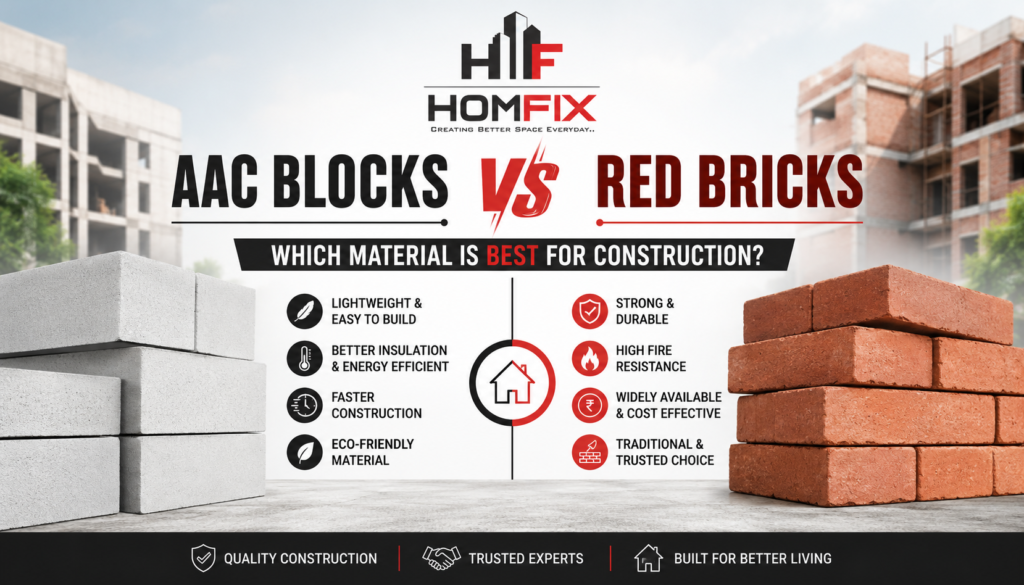
When planning a new home, one of the biggest decisions is choosing the right construction material. The debate between AAC blocks vs red bricks has become increasingly popular among homeowners, builders, and architects. Both materials have their own advantages, but selecting the right one depends on your budget, climate, structural requirements, and long-term goals.
If you’re building a home in Noida, Delhi NCR, or anywhere in India, understanding the differences between AAC concrete blocks and traditional clay bricks can help you make a smarter investment.
In this guide, we’ll compare AAC blocks and red bricks based on strength, cost, durability, insulation, construction speed, and maintenance so you can decide which material is best for your dream home.
What Are AAC Blocks?
AAC (Autoclaved Aerated Concrete) blocks are lightweight precast building materials made using:
- Cement
- Lime
- Sand
- Water
- Aluminum powder
These ingredients create millions of tiny air pockets inside the blocks, making them lightweight while maintaining excellent strength. AAC blocks are manufactured under high-pressure steam curing, which gives them consistent quality.
They are widely used in:
- Residential construction
- Villas
- Apartments
- Commercial buildings
- High-rise structures
What Are Red Bricks?
Red bricks are the traditional building material used in Indian construction for centuries. They are manufactured by molding clay and firing it in kilns at high temperatures.
Red bricks remain popular because they are:
- Easily available
- Familiar to masons
- Affordable in many regions
- Suitable for various construction projects
However, modern construction techniques are gradually shifting towards AAC blocks due to their improved performance.
AAC Blocks vs Red Bricks: Quick Comparison
Weight
- AAC Blocks: Very Light
- Red Bricks: Heavy
Size
- AAC Blocks: Large
- Red Bricks: Small
Construction Speed
- AAC Blocks: Faster
- Red Bricks: Slower
Thermal Insulation
- AAC Blocks: Excellent
- Red Bricks: Moderate
Sound Insulation
- AAC Blocks: Better
- Red Bricks: Average
Fire Resistance
- AAC Blocks: Excellent
- Red Bricks: Good
Water Absorption
- AAC Blocks: Low
- Red Bricks: Higher
Eco-Friendly
- AAC Blocks: Yes
- Red Bricks: Less Eco-Friendly
Strength
- AAC Blocks: High
- Red Bricks: Good
Labor Requirement
- AAC Blocks: Lower
- Red Bricks: Higher
Plaster Consumption
- AAC Blocks: Less
- Red Bricks: More
1. Weight Comparison
One of the biggest advantages of AAC blocks is their lightweight nature.
AAC blocks are nearly three times lighter than traditional red bricks, which significantly reduces the dead load on the building.
Benefits include:
- Lower structural load
- Reduced foundation cost
- Easier transportation
- Faster installation
- Better earthquake performance
Red bricks are much heavier, increasing the overall weight of the structure.
2. Strength and Durability
Many people assume lightweight materials are weaker, but that isn’t true.
AAC blocks offer impressive compressive strength and are suitable for:
- Independent houses
- Multi-storey buildings
- Commercial projects
- Load-bearing and partition walls (as per structural design)
Red bricks also provide good strength but often vary in quality depending on the manufacturing process.
Factory-made AAC blocks offer consistent dimensions and strength, while locally manufactured bricks may differ in size and quality.
3. Construction Speed
Construction time directly impacts project cost.
AAC blocks are larger than traditional bricks, meaning fewer blocks are needed to complete a wall.
Advantages include:
- Faster wall construction
- Reduced labor time
- Less mortar usage
- Better alignment
- Higher productivity
Red bricks require more individual units, increasing laying time and labor costs.
If you’re aiming for faster project completion, AAC blocks are the better option.
4. Thermal Insulation
One of the biggest reasons builders prefer AAC blocks is their excellent thermal insulation.
The tiny air pockets inside AAC blocks help maintain comfortable indoor temperatures.
Benefits include:
- Cooler homes during summer
- Warmer interiors in winter
- Reduced air conditioning usage
- Lower electricity bills
- Improved energy efficiency
Red bricks absorb more heat, making interiors warmer during hot weather.
For Indian climates, especially in cities like Noida and Delhi, AAC blocks provide better thermal comfort.
5. Sound Insulation
If you want a peaceful home, AAC blocks perform significantly better.
Their porous structure helps reduce external noise, making them ideal for:
- Residential homes
- Apartments
- Schools
- Hospitals
- Offices
Red bricks offer decent sound resistance but generally do not match the acoustic performance of AAC blocks.
6. Fire Resistance
Safety should always be a priority in house construction.
AAC blocks are highly fire-resistant and can withstand high temperatures for several hours without losing structural integrity.
Benefits include:
- Improved occupant safety
- Better fire protection
- Compliance with modern building standards
Red bricks are also fire-resistant but may crack under prolonged exposure to extreme heat.
7. Water Absorption
AAC blocks have lower water absorption compared to many traditional clay bricks.
Lower water absorption means:
- Reduced dampness
- Better wall performance
- Lower maintenance
- Improved plaster durability
Some low-quality red bricks absorb excessive water, increasing the risk of seepage and moisture-related issues if proper waterproofing isn’t used.
8. Cost Comparison
Many homeowners assume AAC blocks are expensive.
While the cost per AAC block may appear higher than a single red brick, the overall construction cost often becomes competitive because AAC blocks reduce expenses in several areas:
- Less mortar consumption
- Lower plaster requirement
- Reduced labor charges
- Faster construction
- Lower structural steel requirements
- Lower transportation costs
When considering the total project cost rather than just material price, AAC blocks often provide better value.
9. Eco-Friendly Construction
Sustainable construction is becoming increasingly important.
AAC blocks are considered environmentally friendly because they:
- Use industrial raw materials efficiently
- Generate less construction waste
- Require less energy for transportation due to lower weight
- Improve building energy efficiency
Traditional red bricks consume fertile topsoil and require kiln firing, which contributes to higher carbon emissions.
For green building projects, AAC blocks are generally the preferred choice.
10. Plaster Requirement
AAC blocks have smooth and uniform surfaces.
This results in:
- Better wall alignment
- Less plaster thickness
- Reduced material consumption
- Lower finishing cost
Red brick walls usually require thicker plaster due to uneven surfaces.
Advantages of AAC Blocks
- Lightweight construction material
- Faster project completion
- Better thermal insulation
- Excellent sound insulation
- Fire resistant
- Lower structural load
- Eco-friendly
- Less mortar usage
- Reduced plaster consumption
- Lower long-term maintenance
Advantages of Red Bricks
- Easily available across India
- Traditional and widely accepted
- Suitable for smaller construction projects
- Good compressive strength
- Proven durability when high-quality bricks are used
Which Material Is Better for House Construction?
For most modern residential projects, AAC blocks are the better choice because they offer:
- Better energy efficiency
- Faster construction
- Lower structural load
- Superior insulation
- Reduced labor costs
- Improved sustainability
- Enhanced living comfort
However, high-quality red bricks can still be a practical option in areas where AAC blocks are not readily available or for projects with specific traditional construction requirements.
Ultimately, the right choice depends on your project’s design, location, budget, and the guidance of your structural engineer.
Why Homfix Resolutions Pvt Ltd Recommends AAC Blocks
At Homfix Resolutions Pvt Ltd, we prioritize quality, durability, and cost-effective construction. For many modern residential projects, we recommend AAC blocks because they provide better structural efficiency, improved thermal performance, and faster construction timelines.
Our team carefully evaluates every project to recommend the most suitable building materials based on your home’s design, soil conditions, and budget. Whether you’re building an independent house, luxury villa, or turnkey home in Noida or Delhi NCR, we ensure the use of materials that deliver long-term value and performance.